Leadership Lessons in FFA
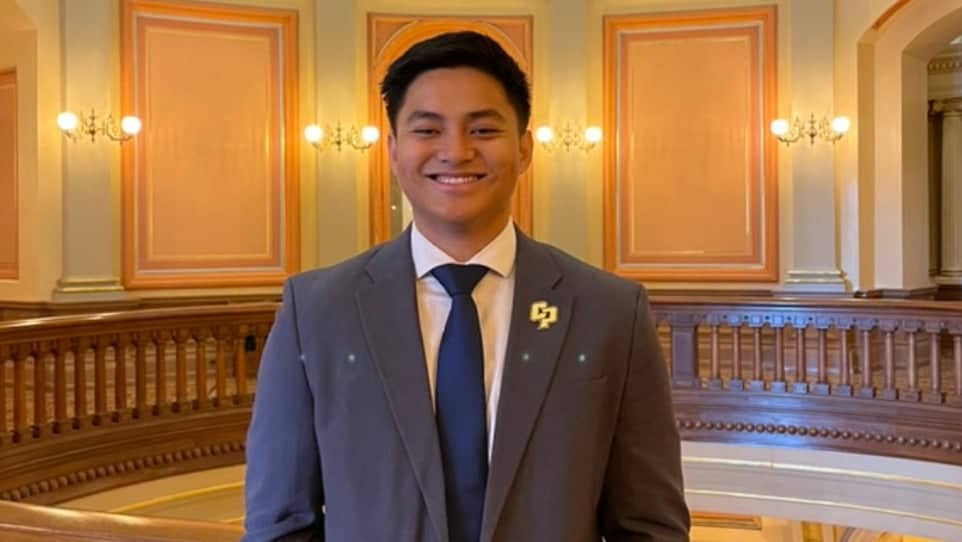 When FFA alumnus Marc Cabeliza arrived for his first year at California Polytechnic State University, he discovered he easily found common ground with students from places as diverse as Eureka, on the northern California coast, or Holtville, only a few miles from the U.S.-Mexico border.
That’s because Cabeliza visited both of those towns, and hundreds more, as California FFA state president. “There were so many new people to meet and new cultures to learn,” Cabeliza says. “Serving as a state officer opened my eyes to the understanding that it’s differences that make a group of people stronger and make them feel like a community.”
He found a strong community in FFA. Born in the Philippines, where his grandparents grew wheat and rice, Cabeliza moved with his immediate family to Santa Maria, California, in 2011. His older sister became heavily involved in the Pioneer Valley FFA Chapter.
“I saw her traveling to different places for free and raising an animal for the fair, all because of FFA, and I wanted to do that, too,” Cabeliza recalls. In his first ag science class, his teachers recognized his leadership potential. Soon he helped develop a pumpkin patch on land slated to become a community landfill, a project Cabeliza used as his Supervised Agricultural Experience (SAE) all through high school.
“That became my niche, because I love hands-on work, but there were also opportunities to help educate the public on the importance of agriculture in our community,” Cabeliza says.
Cabeliza also served his chapter, section and region as an officer, but didn’t initially consider running for state office. “A couple students in my chapter said they thought I’d made a good impact across the state, and I didn’t really understand what that meant until I was in my role in state office,” Cabeliza recalls. He says a pivotal moment came near the end of his term. “A teacher posted a photo of one of his students with me with the caption ‘representation matters.’ The student was so excited to meet me because we both have two first names like most Filipino people do, and now the student wanted to be more involved in FFA. Even though skin color doesn’t matter—there’s a place for everyone in FFA—it is important for kids to see someone like themselves.”
Applying What He’s Learned
Cabeliza has taken these leadership lessons and applied them in his work as president of Cal Poly’s Associated Students, Inc. (ASI), a student-run organization managing campus life and student government. “In my role, I ask myself and the other leaders, ‘how can we continue to appreciate the differences of people around us?’ Because that’s what pushes us all to be better. I also learned a lot about sacrifice from my family, especially my dad, and that sacrifice pushes you to better places. That’s why I wanted these student leadership roles and why I want to continue to do public service in the future.”
As he nears graduation from Cal Poly as a bioresource and agricultural engineering major, Cabeliza is considering his options. That might be working as an engineer because he loves the technical aspect of the field.
But it might be working in public policy, as he’s worked with administrators and elected officials through his leadership roles. “I can see myself making a career in policy and advocacy work,” Cabeliza says. “At the end of the day, I just want to make a good impact.”