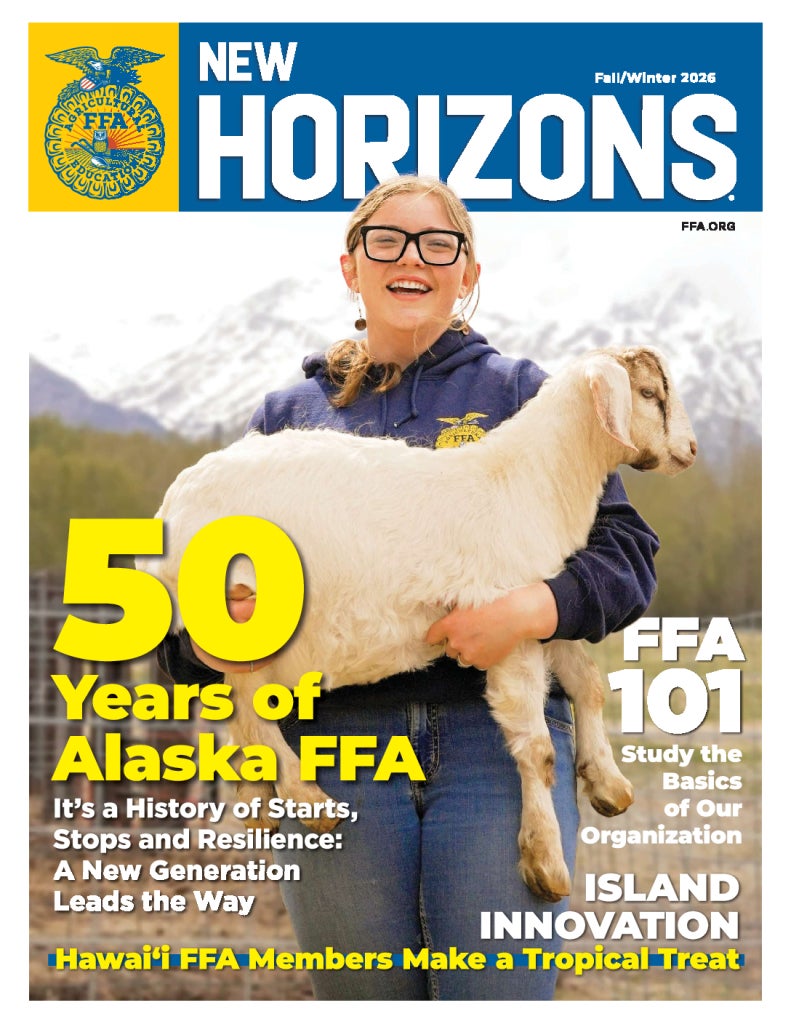
50 Years of Alaska FFA
Liam Wade still remembers seeing empty shelves in the supermarket in North Pole, Alaska, because the COVID-19 pandemic stalled shipments and made food staples disappear faster than expected. In a state where most food travels thousands of miles before it reaches a plate, the impacts were profound. Even though Wade was only in the sixth grade, he wanted to do something.
“We went about two weeks without a single shipment of food into our entire city,” he recalls. “I started researching all these different ways that I could be involved.”
Wade started experimenting with a desktop hydroponic system to learn the nuances of the production method and see how much food he could produce at home. As his interest grew, Wade was eager to expand his skills and asked about opportunities for agricultural education. The North Pole FFA became inactive during the pandemic but restarted in 2023, and Wade was one of the first members; he is also the 2026-27 Alaska FFA president.
“We are the only school in our entire district that has ag education classes,” Wade says. “We focus super hard on getting these career pathways out to students who are interested in them.”
A History of Starts, Stops and Resilience
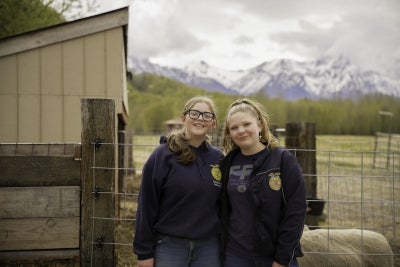
Alaska FFA secretary Isabella Pratt (left) takes a break from chores with her sister, Sophia.
Although Alaskans have a long history of agricultural production, rooted in resilience, building a formal FFA presence proved difficult.
“There were FFA members who moved up with their families in the 1930s, which was when there was a big push to get a population up here,” explains Alaska FFA Association Executive Director Taylor Nelson. “The first FFA charter application was submitted in the 1930s and that was denied because there weren’t enough chapters in the state; it took until 1976 for that to happen.”
Most of the earliest chapters were activated in village schools in rural communities. Larger communities, including Palmer, Delta Junction and North Pole, also established FFA chapters and built momentum for increased statewide participation.
By the early 2000s, Alaska FFA membership had climbed steadily, but the COVID-19 pandemic disrupted everything: Teachers retired or relocated, schools closed due to budget shortfalls and declining enrollment and programs stalled, leaving just six FFA chapters and 100 members statewide. COVID education relief funds helped Alaska FFA rebuild. “We only have a handful of ways to get food into the state, so [the pandemic] created a pressure that there hadn’t been before,” Nelson adds.
In response, more Alaskans started farming. The state has the highest rate of new and beginning farmers in the nation and an 18% increase in the number of small farms from 2017-2022. Alaska FFA has grown, too. The state now has 20 chapters and roughly 500 members, and the Alaska FFA Association celebrates its 50th anniversary in 2026.
Redefining What Agriculture Looks Like
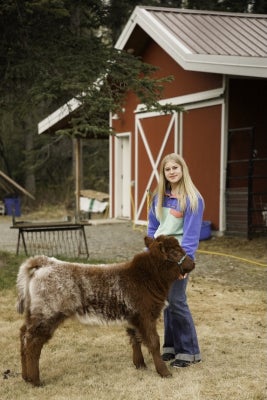
Palmer FFA member Tylynn Sturdivant raises livestock on her family’s farm in Palmer, Alaska.
In many ways, agriculture in Alaska mirrors the Lower 48. Students raise livestock, study plant science and prepare for careers in agriculture, but some of the details and the opportunities are distinctly Alaskan.
Palmer FFA secretary Isabella Pratt breeds and raises market lambs and has won several Grand Champion and Reserve Champion awards. Although it’s a common Supervised Agriculture Experience (SAE) in other states, her family is one of a few sheep breeders in the state, and the unique environmental conditions in Alaska have a distinct impact on the flock.
“The lambs are born in early January, and the process really isn’t very different than the Lower 48,” she says. “We still handle and work them the same, but one thing I have noticed is that the growth rate is exponentially higher for us up here.”
Pratt attributes the faster growth to cooler temperatures. Unlike sheep raised in the Lower 48 that often eat less when it’s warm, sheep raised in Alaska continue eating heartily all year long.
Other SAEs are less traditional. Some students partner with local businesses to raise and show reindeer or sled dogs while others work as fishing or hunting guides or research mariculture through hands-on marine science programs, maintaining saltwater tanks to simulate ocean ecosystems. “Things here are just different,” Nelson says. “There are endless opportunities for anything that you can imagine.”
A New Generation Steps In
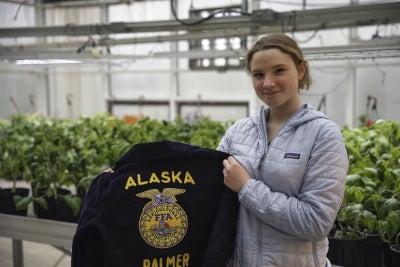
The Palmer FFA Chapter is recognized as the largest chapter in Alaska. Here, chapter president Aleya Leopold proudly displays her FFA jacket.
As Alaska FFA grows, so does its impact on students and their sense of purpose.
Wade started with a small desktop hydroponics setup and expanded into a district-wide initiative that includes eight hydroponic systems in multiple schools that produce about 100 pounds of fresh greens and herbs every three weeks. He donates at least 30% of that harvest to community members; the rest supports school nutrition programs.
“I get to work with the ag classes, getting them involved and helping them understand where their food comes from,” he says.
The hands-on aspect of agricultural education also attracts students eager to see classroom lessons applied in their communities. That sense of belonging is paired with a broader awareness of the challenges facing their state, including the need to build food security.
“They notice when there’s work that needs to be done,” Nelson says. “And often, they’re jumping up and doing it.”
Wade sees that shift firsthand. As he prepares to graduate and attend the University of Alaska Fairbanks, he says he feels confident the hydroponics program he built will be maintained by the FFA members he helped train. More importantly, he believes a growing focus on agricultural education and FFA membership will transform agriculture in Alaska.
“Alaskan agriculture is not far north agriculture; it’s not Arctic agriculture; it’s American agriculture,” he says. “As more states continue to lose agricultural land, Alaska’s continually gaining new land and new opportunities, and we have a generation that’s ready to take advantage of that.”
Coastal Cleanup
Alaska agricultural education is purely unique. Watch the above video about how the Dimond FFA Chapter in Anchorage removes litter, debris and other pollutants from local beaches and coastal areas. Learn more about agriculture and FFA in the state by watching our four-part video series, FFA Across Alaska.
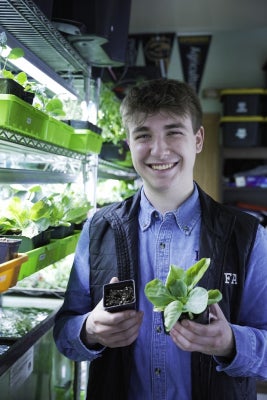
Alaska FFA president Liam Wade.
Impressions From an Early Officer
By Liam Wade, Alaska FFA President
The Alaska FFA Association’s roots run deeper than many realize. The FFA ideals first appeared in the state as early as 1937, when farm families relocated from the Midwest during the Matanuska-Susitna Colony Project. Many of the original pioneers’ children had already been FFA members in their home states and brought its traditions and structure with them to Alaska.
Alaska FFA wasn’t officially chartered until decades later, though. When oil revenue from the trans-Alaska pipeline began flowing in the late 1970s, schools finally had the funding to introduce programs such as agricultural education and FFA. It was a long-awaited arrival for many Alaskans; adults who had hoped for FFA to exist in Alaska during the 1950s spent years waiting for the resources to bring it back. “A lot of the people that [hoped for FFA to charter] in the ’50s were now the ones in positions of authority,” says Don Berberich, a 1979-80 Alaska state FFA officer and retired agriculture teacher and FFA advisor at Palmer High School. “When the opportunity came, they were in a position to make sure it happened.”
That alignment of timing, funding and leadership led to the official establishment of Alaska FFA, including the founding of the Palmer FFA Chapter in 1978. What followed for Berberich was a year as a state officer that formed his future. Reflecting on his experience attending the State Presidents’ Conference in Washington, D.C., Berberich says he entered with low expectations but left transformed. “Every step of the way, I was just blown away.”
By the end of his state officer term, the impact was clear. “I was much different,” he says. “I was humble. I knew the big picture by that time, and I sure saw leadership that was way better than mine.”
Alaska FFA At-a-Glance
By Emily Faulkner, Past Alaska FFA President
1937: Alaska FFA First Attempts a Charter
In 1937, Alaska made its first attempt to become officially chartered in FFA. At the time, Alaska was still a territory and lacked the resources needed to meet national requirements.
1959: Alaska First Represents at National FFA Convention
In 1959, the same year Alaska became a state, it was represented at the National FFA Convention. Bill McKinley of Palmer FFA, one of the first chapters in Alaska, represented the state.
1976: Alaska FFA Chartered
Alaska officially received its FFA charter in 1976, becoming the final state to join the National FFA Organization. This allowed students to fully participate in national events and competitions. It marked a major milestone in Alaska’s agricultural education history.
1976–1984: Alaska Agricultural Action Council Becomes Division of Agriculture
During this time, Alaska strengthened its agricultural leadership and support systems. The Agricultural Action Council transitioned into the Division of Agriculture. Even now, Alaska is one of two states that does not have a Department of Agriculture.
1990: Drought Destroys Agriculture in Interior Alaska
A severe drought impacted farming in Interior Alaska. Crops failed and many producers faced major losses due to dry conditions, including killing the $112 million Delta Barley Project.
2013: Barn Fire Destroys Alaska FFA History
A barn fire destroyed all historical items connected
to Alaska FFA. Important records, memorabilia and pieces of the organization’s story were forever lost.
2014: One of the First States to be Affiliated
Alaska became one of the first states to adopt the affiliation model within the National FFA Organization. This meant students enrolled in agriculture classes automatically became FFA members. The change helped increase membership and accessibility.
2020: Alaska Hosts First All Virtual Convention
Alaska FFA held its first fully virtual state convention due to the COVID-19 pandemic. Members participated in competitions, sessions and leadership activities online.
2025: Alaska FFA Hits 500 Members
Alaska FFA reached 500 members, marking significant growth for the organization, driven by major funding and the State of Alaska’s prioritization of vocational education.