Growing Leaders: How FFA Prepared Lila Christie for Her Future
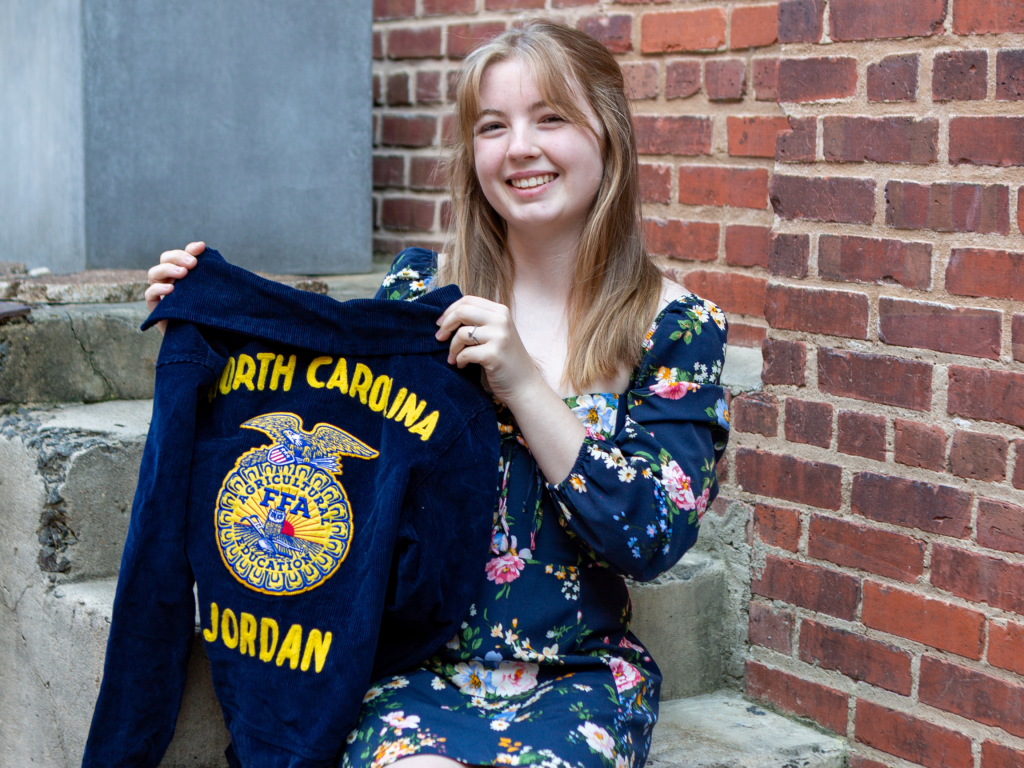
Lila Christie proudly holds her FFA jacket.
As emphasized in its mission statement, the National FFA Organization strives to develop “premier leadership, personal growth and career success” in its members. Since its founding in 1928, FFA has helped millions of members to grow into themselves and develop their leadership skills. One of those members is Lila Christie.
Christie is currently a freshman at North Carolina State University (NCSU) who is double majoring in agroecology and science, technology and society as a Thomas Jefferson Scholar. While in high school, Christie actively participated in the FFA and served as the Jordan FFA Chapter’s president, secretary and treasurer during her senior, junior and sophomore years, respectively.
Through being on the officer team, Christie developed essential skills in communication and collaboration that serve her in college. She notes that much of the work she does involves group projects, and her time in FFA prepared her to work effectively with a team to complete their assignments thoroughly and on time. Additionally, Christie holds leadership roles in the university’s Botany and Agroecology Clubs. Her time in FFA pushed her to pursue roles like this and showed her that she could.
Christie’s time in FFA also provided her with “interview and interpersonal communication skills,” she says, which helped her secure these leadership roles, as well as work multiple jobs, while being a student and ambassador for NCSU.
These interviewing, networking and teamwork skills will also continue to help Christie find success in her chosen career path. Because “agriculture is a tight knit industry, you might be working with someone you know from FFA,” she says. So, being an active part of FFA means members are able to break into this industry and make lasting connections that will help them as they grow.
Through meeting fellow FFA members and her advisors, Christie found her passions and where she fits in the agriculture industry. She reflects that she “learned a lot about [herself] in FFA and was very inspired by [her] agriculture teacher, Ms. Hannah Foust, who travels to Ghana to teach students about agriculture.” Because of Foust’s work in Ghana with the Yonkofa project, Christie developed a desire to have a hand in improving the problem of food insecurity. She also hopes to “solve other social issues through the lens of sustainable agriculture” in the future, she says.
Christie’s journey in FFA built a foundation of skills and knowledge that will support her for her entire life. “I wish that I had been even more involved,” she says. “I did not know about many opportunities above the chapter level, so if you have the chance to attend an event, take it!”
She wants members to know that “high school and being in FFA is a great time to explore what you like and grow your skills before things get too real,” she says, highlighting the importance of taking risks in a time when most have a strong support group they can fall back on.