Tennessee Agriculture Commissioner Andy Holt Challenges FFA Members to Dream Bigger
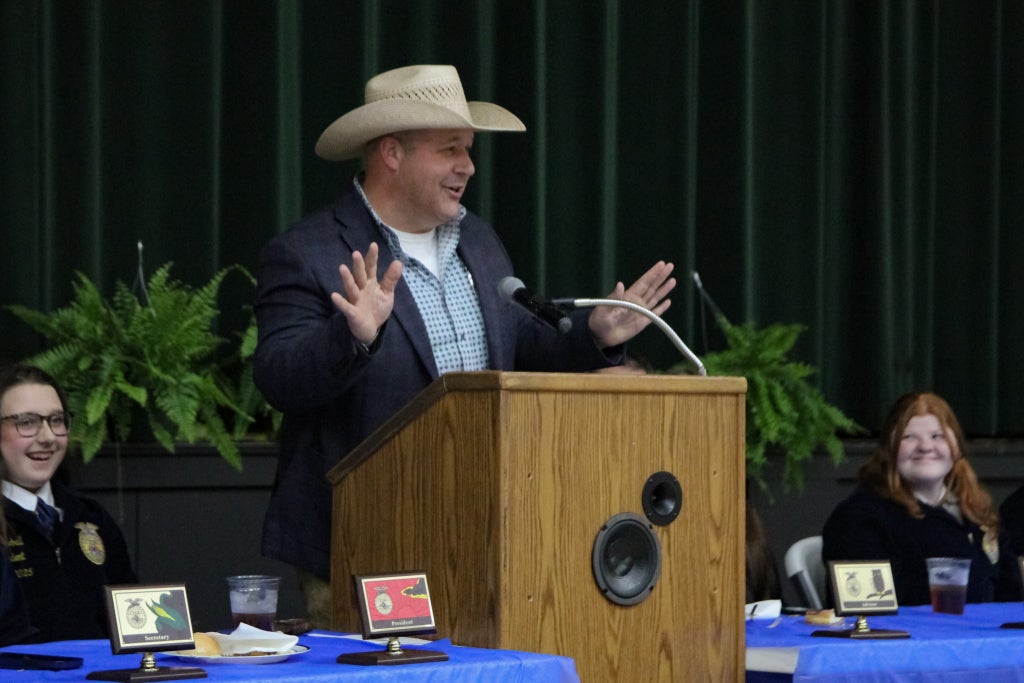
Commissioner Holt speaking at the inaugural Hollow Rock-Bruceton FFA Banquet.
For Tennessee Department of Agriculture Commissioner Andy Holt, agriculture began with an unexpected influence: a second grade teacher.
Long before he ever stepped foot on a farm or worked with livestock, Holt discovered agriculture through reading. His teacher believed every child should learn to read, and often incorporated agriculture into those lessons. That early exposure sparked a curiosity that would eventually lead him into a lifetime of agricultural leadership.
“In second grade, I had never been around a cow or set foot on a farm,” Holt says. “But through learning to read, I learned about agriculture and decided it would be a great place to end up.”
After his family moved to a semi-rural community, Holt became involved in 4-H, where he participated in a chick chain project. He jokingly refers to chickens as the “gateway drug of agriculture.” That first experience quickly grew into involvement with 4-H, FFA Young Farmers and Ranchers and eventually a career serving Tennessee agriculture.
When asked what advice he would give students interested in agriculture today, Holt encouraged young people to seek out challenges that stretch their abilities and push them beyond their comfort zones.
As a teenager, Holt set a goal that many thought was unrealistic. Between his junior and senior year of high school, he moved to North Central Wyoming to work as a cowboy.
“Sometimes, you have to set your sights on something that, when you say it out loud, people think is a little crazy,” Holt says. “Those are the kinds of goals people need to set for themselves.”
Holt credits much of his success to mentors who encouraged him along the way, including his parents, Extension Agent Danny Bullington, FFA advisor Max Sanders and numerous leaders he met through Farm Bureau and Young Farmers and Ranchers programs. He emphasized that mentors often open doors to opportunities that help young people discover their potential.
Beyond technical knowledge, Holt believes success in agriculture begins with strong personal habits. He encouraged students to develop discipline, take care of their physical and emotional health, work hard and learn how to interact effectively with others.
“Learn how to motivate yourself and learn how to deal with people,” Holt says. “Look them in the eye and treat them the way you would want to be treated.”
Holt also reminded students that challenges and setbacks are a natural part of growth.
“If you’re not facing challenges and setbacks every once in a while, you’re probably not risking enough,” he says. “The people who never fail often never accomplish much because they aren’t trying hard enough.”
For FFA members working through Supervised Agricultural Experience projects, Holt encouraged perseverance and resourcefulness. When obstacles arise, he advises students to seek help, recruit additional resources and find creative solutions, rather than giving up.
Looking toward the future, Holt sees tremendous opportunity in agricultural technology. He encouraged students to become early adopters of innovation and to stay curious about emerging trends and production methods.
“Agriculture is always changing,” he says. “The sun is always rising in agriculture. There’s always a new horizon and always new opportunities.”
If he could issue one challenge to FFA members across Tennessee, Holt said it would be to regularly evaluate their own growth and goals.
“Nobody can make decisions for you,” he says. “Be honest with yourself. Are you making the right decisions? Have you advanced? Writing goals down and pursuing them with all the resources available to you is important.”
Holt also challenged young people to think about the choices they make as consumers. He encouraged the next generation to support American agriculture by choosing products made from natural and domestic materials whenever possible.
“We vote with our money every day,” Holt says. “When we support American agriculture and American-made products, we’re investing in our communities and our future.”
One of Holt’s favorite agriculture memories came from his family’s decision to diversify their farm through agritourism. While many questioned the idea at the time, the venture ultimately proved successful and reinforced an important lesson.
“Sometimes, doing things differently and taking risks is rewarded,” he says.
Whether serving as a farmer, legislator or now as Tennessee’s Commissioner of Agriculture, Holt says the most rewarding part of his work remains the same: helping people.