More Than Farming: Agriculture’s $117 Billion Impact on North Carolina
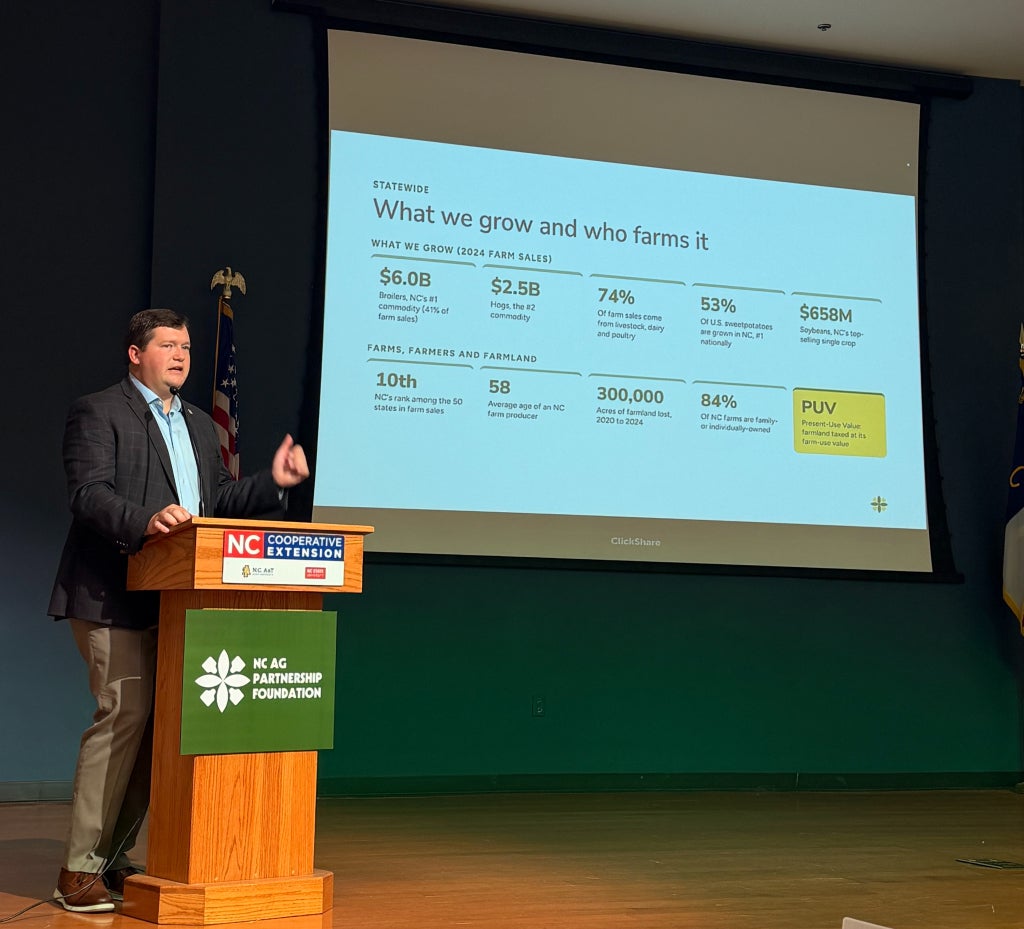
On Oct. 7, the NC Ag Partnership Foundation hosted the Digital Driven Ag Event, bringing together people from 10 North Carolina counties to learn about agriculture and its impact on their communities. Attendees represented a variety of backgrounds, including education, government, and the industry of agriculture.
The event kicked off with a reality check: attendees took an Ag IQ test presented by Megan Hatfield. The test put the attendees on the spot with questions such as “How many North Carolina jobs are connected to agriculture?” and “Which sector contributes the most to agricultural economic impact?” The answers were approximately 1 in 6 North Carolina jobs and food and related products, respectively. One of the most notable figures was the reported $117 billion total economic impact of North Carolina agriculture and agribusiness. The answers on the first run-through of the test were a little rough but were mostly on point. Then, on the second run-through at the end of the event, a good portion of the questions were answered with 100% accuracy, showing improved knowledge.
The main speaker at the event was NC Ag Partnership Executive Director Adam Caldwell. He presented a slideshow explaining agriculture’s economic impact on the state. He also shared that 53% of the nation’s sweet potatoes are grown in North Carolina. His presentation highlighted the reported $117 billion economic impact of North Carolina agriculture and agribusiness.
One local example was Johnston County, which accounted for $1.9 billion of the reported statewide economic impact. The county also ranked second in North Carolina for tobacco production. Caldwell also presented economic impact data for nine other counties: Wake, Durham, Alamance, Lee, Orange, Harnett, Chatham, Person and Franklin. For each county, the presentation included data on total economic impact, employment, wages, salaries, and proprietor income, along with key takeaways and additional facts.
Each county’s numbers told a story about agriculture’s role in its local economy. The data helped attendees understand the economic impact agriculture has on them and their neighboring counties. These county statistics sparked conversation between attendees after the presentation and helped them recognize the connections between their counties and the surrounding region. There were also handouts available for each county displaying the information. Many people even took handouts for other counties. As an attendee, I picked up a couple of handouts and took notes throughout my time there. I found the information to be quite informative, and it helped me understand agriculture’s role in local economics.
After the presentation and the second run-through of the Ag IQ test, Peter Daniel, board chair of the NC Ag Partnership Foundation, gave closing remarks.
He said, “When people who make decisions understand agriculture, they make better decisions for everyone, not just the farmers, everybody.”
Daniel’s remarks captured the purpose of the event: helping attendees better understand agriculture’s impact in their own counties and the counties around them. He also mentioned these statistics, and more are available at https://www.ncapfoundation.org/research.