A Blueprint for the Future: Shaping Leaders From the Classroom to the Global Stage

Dr. O.P. McCubbins, assistant professor at Mississippi State University.
When people hear “FFA,” they may picture a classic barn.
But according to Dr. O.P. McCubbins, an assistant professor of agricultural education at Mississippi State University, what is actually happening inside that barn is a sophisticated hotbed for systems thinking, problem solving and communication under pressure.
In a recent interview, Dr. McCubbins broke down how the unique structure of agricultural education prepares students for high-stakes careers, why doing comes before knowing and how a sense of responsibility connects FFA members to global agricultural leaders half a world away.
Agricultural Education: The Science of Adaptability
For Dr. McCubbins, the true power of FFA lies in its integration with the classroom. It isn’t just an after-school activity; it is a fundamental part of the school day where theory immediately meets practice.
“When you join a random club, you’re adding something to your day. When you’re in FFA, it is your day,” Dr. McCubbins says. “It’s built into the class, which means the learning and the doing aren’t separated—they’re the same thing.”
This model is most obvious in Supervised Agricultural Experiences (SAEs), where students manage their own agricultural ventures. Dr. McCubbins stresses that these projects are far more than graded assignments; they are real-world operations with tangible stakes.
“A kid running an SAE isn’t completing an assignment. They’re running an actual business, managing a budget, facing failure and iterating,” Dr. McCubbins says. “That process of doing first, and then deepening understanding, is exactly what learning science tells us leads to retention and transfer.”
This hands-on frustration is where the real growth happens.
“They’re making real decisions with real consequences. And when something goes wrong (and something always goes wrong), they have to figure it out. That’s not a simulation. That’s the work,” he says. “For our future? We need people who can adapt, not just people who can recall. FFA produces adapters.”

Dr. McCubbins presenting on innovative teaching tools and technology in agricultural education.
Building Mental Models Outside the Barn
While the physical work takes place in greenhouses and barns, Dr. McCubbins points out that the mental models students build are highly transferable to modern, high-tech industries. Whether a student is fixing a piece of machinery or participating in a leadership development event like extemporaneous speaking, they are training their brains for future leadership roles.
“When you’ve had to figure out why something isn’t working with your hands on it, you’ve already built the mental model that high-tech work demands later,” Dr. McCubbins says. “Extemporaneous speaking? You’ve got 30 minutes to synthesize information you’ve never seen before and present it clearly. That’s a skill set.”
Those high-pressure high school moments lay the groundwork for long-term career success, long after the blue corduroy jacket is hung up for the last time.
“When that same kid is 28 and leading a tech team or managing a precision ag operation, those instincts don’t go away,” Dr. McCubbins adds. “They just get applied in a bigger room.”
A Global Common Denominator
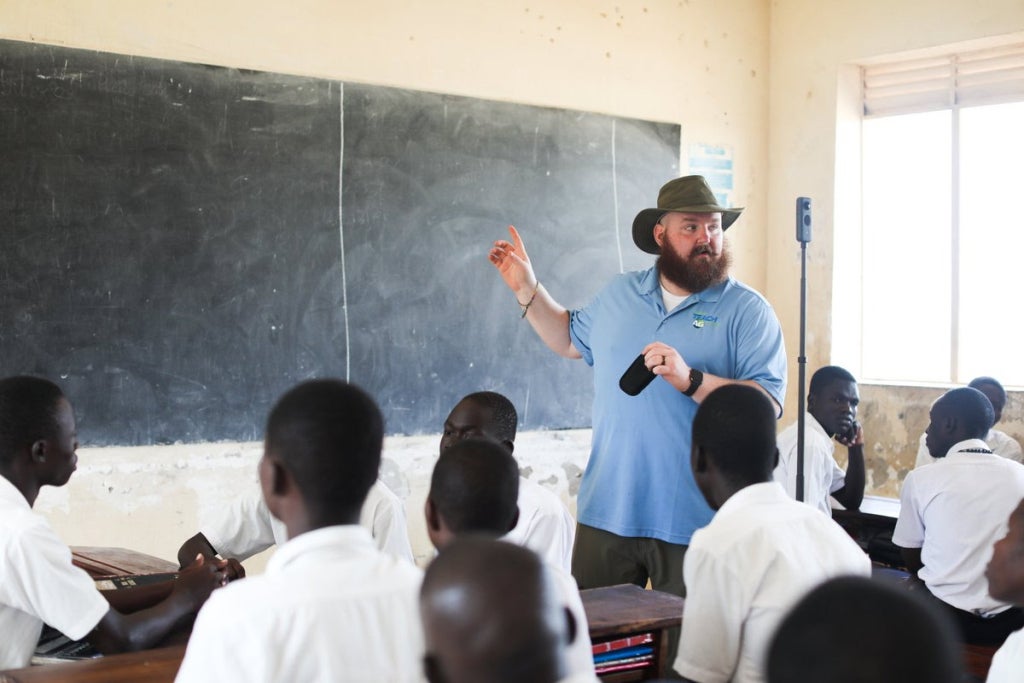
Dr. McCubbins engaging with students in an international classroom setting, highlighting the global reach of modern agricultural literacy.
Dr. McCubbins’ perspective on leadership isn’t limited to domestic classrooms. Having worked alongside agriculture educators and leaders in Uganda, he was struck by the immediate familiarity of the innovators he met abroad, despite the vastly different environments.
“My first thought was honestly ‘I know this person!’ The context was completely different—the crops, the infrastructure, the scale of the challenges,” Dr. McCubbins says. “But the orientation was the same. They were deeply connected to their communities. They were still learning, even while they were leading.”
Ultimately, Dr. McCubbins believes that whether a leader is navigating an urban food system in America or managing a smallholder farm in East Africa, the core values of agricultural education remain universal. It all comes down to a deep-seated commitment to service.
“The universal thing, if I had to name one, is a sense of responsibility that extends beyond yourself,” Dr. McCubbins says. “The best FFA leaders I’ve known—and the best agricultural education leaders—are always asking, ‘Who else does this serve?’”
Read more feature profiles on FFA in the USA.