These Ag Lessons Reach Global Audience
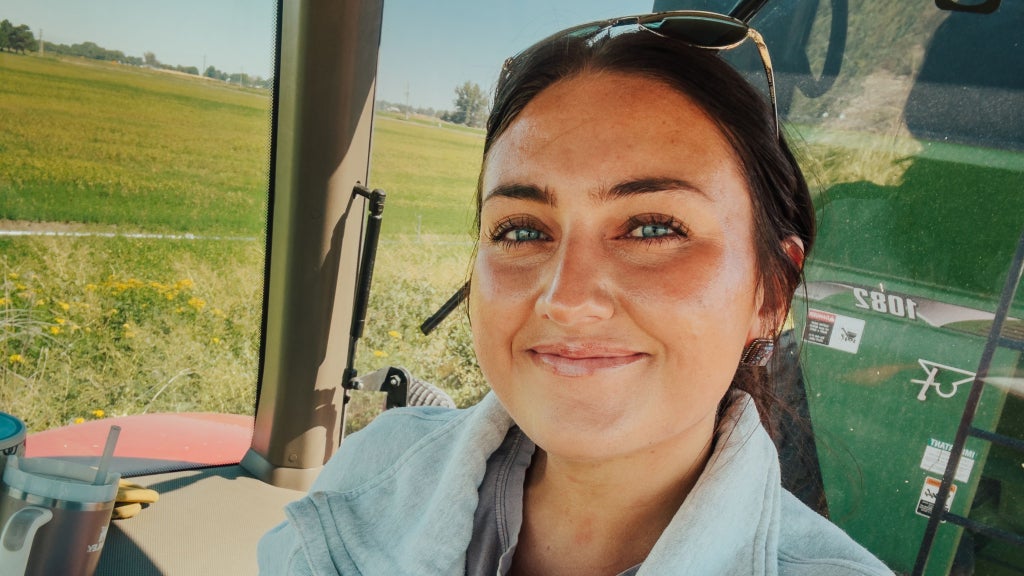 Saydee Longhurst considers herself an ag educator, but she doesn’t teach a class of high school students or advise an FFA chapter.
The past Idaho State FFA president has thousands of followers on social media, sharing the daily happenings on her family’s alfalfa and wheat farm near Shelley, Idaho. Her posts range from funny snippets about what she and her dad are wearing in the combine to thoughtful, short essays on the true meaning of “agriculturalist” (hint: it’s anyone who eats food or wears clothes).
As a high school student, FFA helped Longhurst realize the agriculture industry held many career possibilities, in addition to traditional farming. Opportunities for leadership helped her see the sense of community found in FFA, which extends throughout the entire ag industry and ultimately to communities nurtured online. FFA also helped push Longhurst into a deep dive into social media.
“When I was preparing to run for state office, I was really nervous,” she recalls. “No one from my chapter had even been a candidate for 30 years, so I didn’t have anyone to look to for experience or advice. To prepare, I had people interview me and nearly all of them said I should tell my own story. I thought hard about what my story would be and when the state interviews came, I was ready to share that.”
Finding Her Voice
As state president, Longhurst quickly discovered a strong desire to tell the stories of the FFA members she represented. She began documenting her travels to chapters across the state, her visits with elected officials in Washington, D.C., and the opportunity to participate in a roundtable discussion with other state presidents and then-Secretary of Agriculture Sonny Perdue. “This was a chance to talk with someone quite literally making policy affecting things for my farm in Idaho and for other FFA member’s livelihoods,” she says.
She also realized her love for teaching others and enrolled at Utah State University to earn a degree in agricultural education. She used social media to explain what agricultural education students learn and what careers are possible after graduation. Longhurst student-taught at Idaho’s Rigby High School and at an agricultural high school in Milan, Italy. “That school had a farm where they raised alfalfa,” says Longhurst, who shared posts comparing alfalfa production practices and yields between Italy and Idaho. “I loved sharing that ag education is global.”
Her student teaching stints led Longhurst to believe that ag teachers should actively share their experiences online. For her master’s degree at Utah State, Longhurst studied ag teachers’ use of social media to highlight classroom experiences, FFA achievements and Supervised Agricultural Experience (SAE) projects, and audience response to those posts. “It was clear we’re able to connect students to agriculture in ways we couldn’t before we had the online platforms we have now,” Longhurst says of her findings.
Authentic Ag Education
Taking that research to heart, Longhurst has committed to her use of social media to document her life on the farm. “Instead of calling it ‘preparing content,’ I see my posts as teaching about agriculture,” she says. “Authenticity and formatting information in a digestible way are crucial.” For years, she’s posted Ag Fact Fridays on her Instagram stories, where she posts short quizzes about seasonal topics ranging from how many turkeys are consumed on Thanksgiving to the number of commodity crops in Idaho. She’s currently doing a basic ag terminology series on TikTok and Instagram; the first few focused on alfalfa and wheat and covered everything from explanations of test weights to grain carts. She says the posts mimic the content she’d cover if she was teaching in a physical ag classroom.
She’s interested in such a position, but right now she’s focused on helping on her family’s farm and growing her small hay baling business, Cleo’s Cuttings, which began as a SAE when she was in high school. She also manages the social media accounts for the Shelley School District, her alma mater, and for the National Center for Agricultural Literacy at Utah State University.
“By educating online, I feel I have a bit more freedom than I would in a traditional classroom to teach topics where I feel there are gaps, and to reach all kinds of folks, not just high school students,” she says. “I really love that about teaching in an online setting.”