How Scrolling Became Award-Winning Research
A farmer posts a video explaining how their crops are grown. Someone scrolling past stops to watch. Another person leaves a question in the comments. But are the two actually understanding each other?
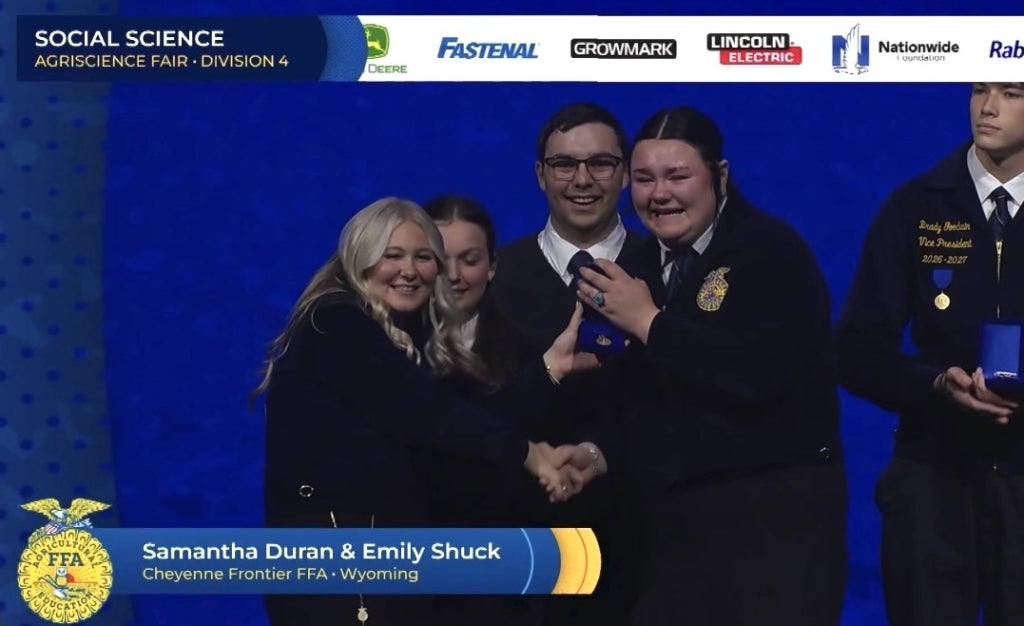
For Emily Shuck, that question became the foundation of a National FFA Agriscience Fair-winning research project.
What started with scrolling through social media turned into an investigation into how demographic factors influence how people receive agricultural content online. Through her project, Shuck wanted to better understand the connection between agriculturists creating content and consumers viewing it.
From Scrolling to Research
Shuck’s project, “Scrolling for Truth: Analyzing Demographic Influences on Acceptance of Agricultural Social Media Marketing,” explored how different demographic factors influence people’s acceptance of agricultural content on social media.
The idea came from something she already knew well: social media.
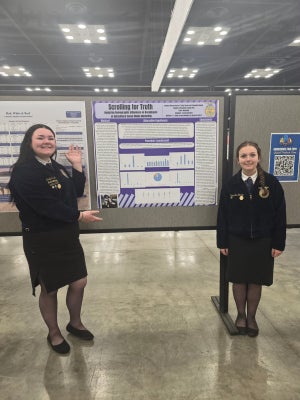
Emily Grace Shuck and Samantha Duran showcase their National Champion’s agriscience project, “Scrolling for Truth.” Photo by Bailey Felix, the Frontier FFA advisor.
While running her own agricultural advocacy account, “Agriculture with Emily,” Shuck noticed comments and conversations that made her wonder whether farmers and consumers were really understanding each other online. She saw farmers who didn’t always know how to use social media effectively, while consumers sometimes didn’t know how to interpret the agricultural content appearing on their screens.
Rather than simply observing those interactions, she decided to investigate them.
Her research tested nine hypotheses. Three were supported, while six were not. Some of the results challenged what she originally expected. She thought education level and the amount of time someone spent on social media each day might have a greater influence. Instead, age, gender and the population of where someone lived were among the factors supported by her findings.
The results helped Emily explore how agricultural businesses could approach their online marketing differently.
From butcheries to floriculture shops, she saw opportunities for businesses throughout the industry to use social media to market products, reach consumers and build stronger connections.
When the Research Got Real
Behind the finished project was far more work than a few minutes of scrolling.
During the final months of preparing and revising her research for the national competition, Shuck sometimes spent up to 15 hours a week working on the project.
Even with all that preparation, questions about whether her research would be successful remained.
At the state agriscience competition, Shuck and her teammates presented alongside other strong projects. Their speaking styles were completely different, which initially made her nervous. However, those differences ultimately became an advantage for the team.
The uncertainty followed her beyond the competition, too.
After state, Shuck was attending a parliamentary procedure practice when her agriculture teacher brought in the list of agriscience finalists. While she was focused on answering a question, her teammates wrote the finalists’ names on the board behind her.
She turned around.
Her name wasn’t there.
Shuck began crying, believing the project hadn’t advanced. After all the hours she had invested, seeing her name missing was difficult.
Then her teammates revealed they were joking.
The moment gave Shuck a scare, but it also reflected just how much the project meant to her. She had spent so much time questioning whether her research was specific enough to make a difference that even the possibility of not advancing felt overwhelming.
Finding Strength in the Bigger Picture
After winning at the state level, Shuck returned to the project rubric and began looking at her research differently.
One concern had followed her throughout the process: Was her project too broad to actually help anyone?
But its wide range of potential applications was also what made the research valuable. Rather than focusing on just one agricultural business or audience, her findings could help agriculturists across different areas of the industry think about how they communicate with consumers.
That opportunity eventually took Shuck and her teammate, Samantha Duran, to the national stage.
The pair earned national champion recognition in the National FFA Agriscience Fair‘s Social Science Division 4 with their project, “Scrolling for Truth.”
An Ally, Not an Enemy
For Shuck, the project represents more than a national championship. It is an opportunity to change how agriculturists approach social media.
She hopes farmers and agricultural businesses can become more comfortable using online platforms to market their products, connect with consumers and share agriculture’s story.
Social media doesn’t have to be an enemy. When used thoughtfully, it can become an ally.
Through her research, Shuck turned something as ordinary as scrolling through social media into an opportunity to ask questions, challenge assumptions and explore new ways to advocate for agriculture.
Sometimes, the next big research question isn’t found in a laboratory or a textbook. Sometimes, it starts with something right in front of us; even a scroll through our phones.