Brandon Reed: Exploring the Impact of Agricultural Professionals in Local Communities
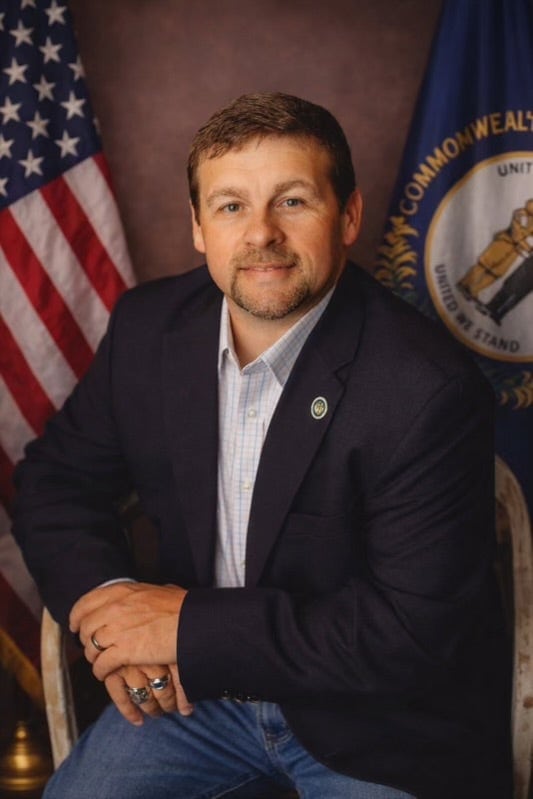
Brandon Reed, executive director for the Kentucky Office of Agricultural Policy.
There are countless FFA alums and agricultural professionals who have contributed to the agricultural community in an abundance of ways. Each individual has their own personal journey in which agriculture affects their role in their community. Green County FFA Reporter Anna Warf interviewed a well-respected name in the agricultural community at the local, state and national levels to highlight the individual journey and impact of agricultural professionals and FFA alums.
William Brandon Reed is the current executive director for the Kentucky Office of Agricultural Policy within the Kentucky Department of Agriculture. He served 10 years with the Kentucky Administrative Office of the Courts as a deputy circuit clerk and field representative. He also served four terms as a state representative for the 24th House District (Green, Hart and LaRue Counties) in the Kentucky General Assembly. In this role, he served as vice-chairman of the House Appropriations and Revenue Committee, chairman of the Nonprofit Task Force, chairman of the Education Assessment and Accountability Committee, chairman of the Equine Committee, and chairman of the Empower Disability Caucus. He also served on the Agriculture, Appropriations and Revenue, Local Government, Tourism, Veterans, Tobacco Oversight, Budget Preparation, Budget Conference, and Budget Review Committees.
In addition to his impressive involvement with Kentucky agriculture, Reed is a licensed minister with Worldwide Evangelism.
Early Agricultural Days
Reed was born on a fifth-generation family farm where he grew up raising cattle, tobacco, hay and row crops. Reed reflected on his early agricultural experiences, saying, “My grandfather was a career farmer; my father served the Kentucky Department of Agriculture for 31 years. Our family dinner conversations revolved around current events, government and agriculture. Early on, I would hear my father recite the FFA Creed, which planted a seed to always do my part in that inspiring task.”
Reed’s FFA career was an impressive one, and it started in 1995 in the LaRue County FFA Chapter. “My FFA advisor always stated, ‘You get out of the FFA what you put into it,’” he says. “I took that challenge to heart.”
He loved competing in career and leadership development events, such as Creed speaking, quiz, land judging, prepared public speaking, impromptu speaking, parliamentary procedure, proficiencies, job interview and more. Reed also earning Star Greenhand, as well as chapter, state and national leadership awards.
Throughout his years in FFA, he enjoyed attending the Kentucky FFA Leadership Training Center and state and national conventions. Reed served as his chapter’s president during his junior year, as the Lincoln Trail regional president his senior year, as a camp council president, as a two-time national delegate, as the 1999-2000 Kentucky state FFA president and as a National FFA committee chairman. Furthermore, holds his Greenhand, Chapter, State and American FFA Degrees. He was also presented with his State Honorary Degree and holds a Lifetime Alumni Membership.
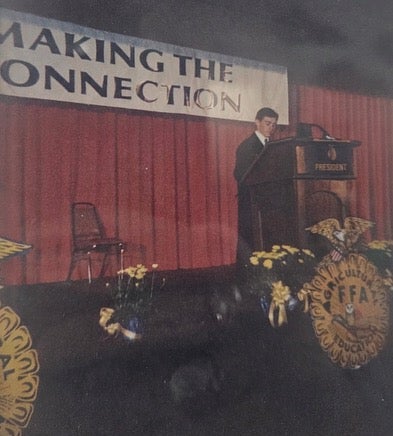
Reed addresses Kentucky FFA at the Kentucky State FFA Convention during his time as state president.
Agriculture’s Impact
When asked to define agriculture in his own words, Reed said, “Agriculture is the foundation of our communities and the engine of rural economic development. It is the daily work of farmers and producers who steward the land, feed our families, fuel our economy and pass down a legacy of faith, family and hard work from one generation to the next. On the eighth day, God made a farmer.”
Reed acquired many different skills and values from his agricultural experience that he still uses today. Among these are leadership, public speaking, parliamentary procedure, work ethic and how to serve others. He pursues strengthening these skills every day. “Success is falling down in the field of life, standing back up and getting back to work,” he says.
For the last 10 years, Reed has worked heavily in agricultural policy at the state and national levels. He tries to make it easier for farmers to pursue their passion, without heavy burdens or regulations, while protecting consumers and capitalizing on markets. He and his colleagues serve every day with the next generation at the front of their minds, while also working the soil with today’s farmers.
“We move agriculture forward every moment, one conversation and one handshake at a time,” Reed says.
In a typical day, Reed travels across the Commonwealth, attending meetings, serving on boards and standing alongside his employees, who execute the Kentucky Agricultural Development Board, Kentucky Agricultural Finance Corporation and Kentucky Agricultural Economic Development Board’s will.
“Over the past 25 years, we have strategically invested over $800 million across the Commonwealth, diversifying Kentucky’s agricultural landscape,” Reed says. “I conduct meetings with commodity groups, trade organizations and the Kentucky General Assembly, advocating for sound policies and opportunities.”
Green County, Ky., has around 900 farms and 145,130 acres in agricultural production. It produces around $78 million in agricultural products and $25 million in net farm income. Around 59% of sales come from crops, and 41% comes from livestock/poultry.
“Agriculture supports local businesses, families and culture,” Reed says. “In Green County, agriculture isn’t just an industry; it’s the backbone of the economy, the primary use of the land and a way of life for hundreds of citizens.”
However, there are many challenges that current and future farmers are facing. Among these are farm succession, rising input costs and labor shortages. “At its core, the biggest challenge is profitability and sustainability,” Reed says. “If farms cannot remain profitable across generations, rural communities, local economies and food systems all feel the impact.”
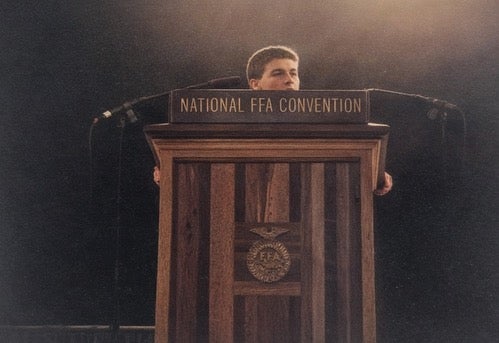
Reed speaking on stage at the National FFA Convention during his high school FFA days.
In conclusion, Reed was asked what advice he would give to a young person interested in pursuing a career in agriculture.
“Agriculture rewards those who show up early, stay late and push through the hard days,” he says. “There will be long hours and tough seasons, but hard work still wins in the field. The National FFA Organization is the premier leadership opportunity to learn, grow and pursue your vision for your life, family and community. E.M. Tiffany said it best in the FFA Creed when he wrote, ‘I believe that American agriculture can and will hold true to the best traditions of our national life, and that I can exert an influence in my home and community, which will stand solid for my part in that inspiring task.’ Trust in the Lord with all your heart, build relationships and serve others with kindness and resolve.”