More Than A Merger — The Black History Behind FFA
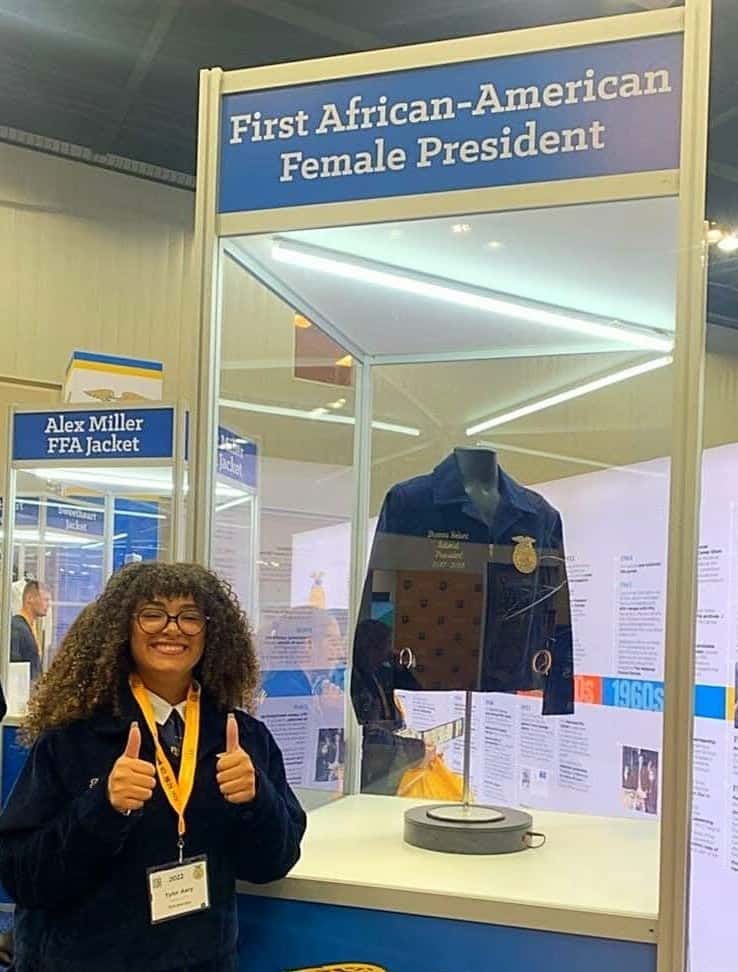
During the National FFA Convention & Expo, FFA in the USA Reporter Tylor Aary poses with the jacket of Breanna Holbert, the first African-American female to be elected president of FFA.
Every February, people in the United States celebrate the achievements and sacrifices of African Americans during Black History Month.
Black History Month began as a week-long observance in 1915. Historian Carter G. Woodson co-founded the Association for the Study of Negro Life and History. In 1926, the organization’s leaders established “Negro History Week” to raise awareness of the significant contributions Black Americans made to U.S. history.
The second week of February was intentionally chosen because it honored influential figures whose birthdays fell during that time, including abolitionist Frederick Douglass and former U.S. President Abraham Lincoln, who led the nation during the Civil War. After five decades of a week-long celebration, Negro History Week was officially expanded into Black History Month in 1976. President Gerald Ford endorsed the extension, urging Americans to “honor the too-often neglected accomplishments of Black Americans in every area of endeavor throughout our history.”
The National FFA Organization is an important part of our history as FFA members. Being involved in the organization means developing a deeper understanding of the people and events that came before us—especially those that made our present opportunities possible. That includes the New Farmers of America (NFA), founded in 1935 at the Tuskegee Institute in Alabama. NFA was a thriving organization with over 58,000 Black members focused on agriculture and leadership. On July 1, 1965, NFA and FFA merged into one organization. The merger resulted in the loss of many NFA chapters, leading to a decline in leadership opportunities and membership for Black students.
Since the merger, African-American membership has slowly grown to encompass nearly 6 percent of the total FFA membership. In 1973, Fred McClure from Texas was the first African American elected to a national FFA office as secretary. Corey Flournoy, from Illinois, was the first African American elected president in 1994. And in 2017, Breanna Holbert from California became the first African-American woman elected president.
Today, the National FFA Organization stands as one of the top student-led organizations in the country. However, its continued success depends on preserving and acknowledging the history that allowed it to thrive. The stories, struggles, and sacrifices of those who came before us must never be forgotten, so future generations can continue to grow with purpose and understanding.